

Book Online
Please choose which location you would like to make an appointment for.
Rigid gas permeable contact lenses, or RGPs, can improve vision affected by an irregular cornea.1
At Innovative Eye Care, we fit custom RGP contact lenses at our Adelaide and Henley Beach practices. Our optometrists combine diagnostic imaging, EyeSpace lens design software and assessment of the lens on your eye to tailor your lenses to your corneal shape and prescription.


RGPs retain their shape on the eye. Their optical surface and the tear layer beneath help compensate for corneal irregularity.1
This page focuses on corneal RGP lenses. These smaller rigid lenses sit on the cornea, the clear front surface of your eye, and move as you blink. They differ from larger scleral lenses, which bridge over the cornea.2
You may also hear RGPs called “hard contact lenses”. Modern gas permeable lenses use different materials from older hard lenses.
Keratoconus changes the shape of the cornea and can make glasses less effective. RGP lenses can improve vision by compensating for corneal irregularity. They are an established option for visual rehabilitation in keratoconus.3
Explore our contact lenses for keratoconus to compare the available designs.
Custom RGPs may suit prescriptions or eye shapes that standard soft lenses cannot accommodate. We assess your vision and fit before recommending them.4
Some people still need specialty contact lenses after corneal cross-linking, corneal rings or a corneal transplant. The choice depends on the shape and health of the cornea, vision and lens tolerance.2
Read about our care before and after keratoconus surgery.
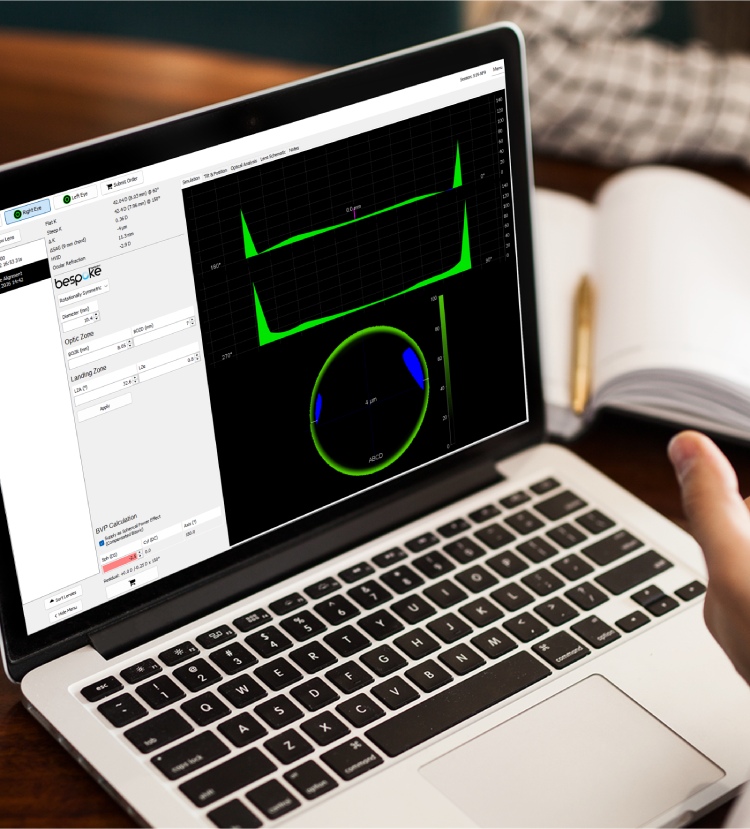
Your lens prescription is only part of the design. The back surface of the lens must also suit the shape of your cornea.
At Innovative Eye Care, we use EyeSpace software to design bespoke RGP lenses using corneal measurements and your prescription. EyeSpace supports virtual design of custom day-wear corneal RGPs from eye imaging data.
Our optometrists use this information to plan the lens shape, size and optical correction. The aim is to achieve an appropriate fit and useful vision for your individual eye.
Research supports corneal topography as a tool for planning RGP lenses. A clinical study found that topography-based software could produce suitable lenses for people with keratoconus, sometimes with parameter adjustments. That study assessed a different software system, so it supports the fitting approach rather than proving an EyeSpace-specific outcome.5
Digital design provides a starting point. We still assess the manufactured lens on your eye and refine it when needed.
Different scans answer different questions. We select imaging according to your corneal shape, eye health and fitting needs.
Corneal topography maps the curvature of the front surface of your cornea. Our Medmont measurements identify steepness, flattening and asymmetry to guide lens design.5
Corneal tomography, including Pentacam imaging, assesses the front and back corneal surfaces and corneal thickness. This adds information about corneal structure in keratoconus.1
Wavefront aberrometry measures optical distortions beyond a standard prescription, helping assess visual quality in keratoconus.1

We assess your prescription, vision, cornea, tear film and eyelids. We also discuss previous lens wear, your daily activities and what you want to improve. Bring your current glasses, lenses and care products to the appointment.
We obtain the corneal measurements needed for your fitting and use EyeSpace to plan a custom lens. Depending on your eye and the design, diagnostic lenses may also help assess your response before the final lens is ordered.
Once your lenses arrive, we check their position, movement and alignment. Fluorescein dye helps show the tear pattern beneath a corneal RGP. We also measure your vision and check whether the prescription needs refinement. These checks form part of evidence-based rigid lens fitting.4
We teach you how to insert, remove, clean and disinfect your lenses. You receive instructions on wearing time and follow-up.
Follow-up allows us to assess comfort, wearing time, vision and corneal health. We may adjust the lens design or prescription. Structured assessment, a planned wearing schedule and aftercare are central to RGP fitting for keratoconus.3

Corneal RGPs and scleral lenses are both made from gas permeable materials, but they fit differently. A scleral lens is larger and rests over the white part of the eye, with a fluid layer beneath it.
Scleral contact lenses may help when corneal RGPs are uncomfortable or unstable. Your eye and lens tolerance guide the choice.2
We will discuss the options after assessing your eyes and previous lens experience.
You may notice the lenses when you blink during the early stages of wear. Adaptation varies, and your optometrist will give you an individual wearing schedule.4
Tell us if discomfort persists or wearing time remains limited. We can review the fit, tear film and care routine rather than asking you to tolerate an ongoing problem.
Pain, persistent redness, light sensitivity or a sudden change in vision needs prompt assessment. Remove the lenses and contact us.
Contact lenses can cause irritation, corneal injury or infection. Appropriate care and regular review help manage these risks.6
Wash and dry your hands before handling your lenses. Use the cleaning and disinfection products recommended for your specific lenses. Use fresh solution and follow the product instructions. If you use a peroxide system, allow it to neutralise fully before inserting your lenses.
Keep your lenses and case away from tap water. Remove lenses before showering or swimming. Do not sleep in ordinary day-wear RGP lenses. Water exposure, overnight wear and poor hygiene can increase the risk of contact lens complications.6
Follow our RGP lens care and handling guide, together with the instructions provided at your fitting appointment.
If glasses or standard contact lenses are not meeting your needs, our optometrists can assess whether custom RGP lenses may help.
Adelaide: 300 Wakefield Street, Adelaide SA 5000. Phone (08) 8231 9341.
Henley Beach: 330 Seaview Road, Henley Beach SA 5022. Phone (08) 8445 9050.
Book your appointment now for personalised eye care tailored just for you.